AD

02 / Work

The work
in full.

Across hardware, medtech, social enterprise, and teaching. The thread through all of it: building things that matter to people.


Medtech · Wearable Hardware

Feb 2025 – Present
Melbourne, Australia

Melbourne Bionics

Founding Engineer

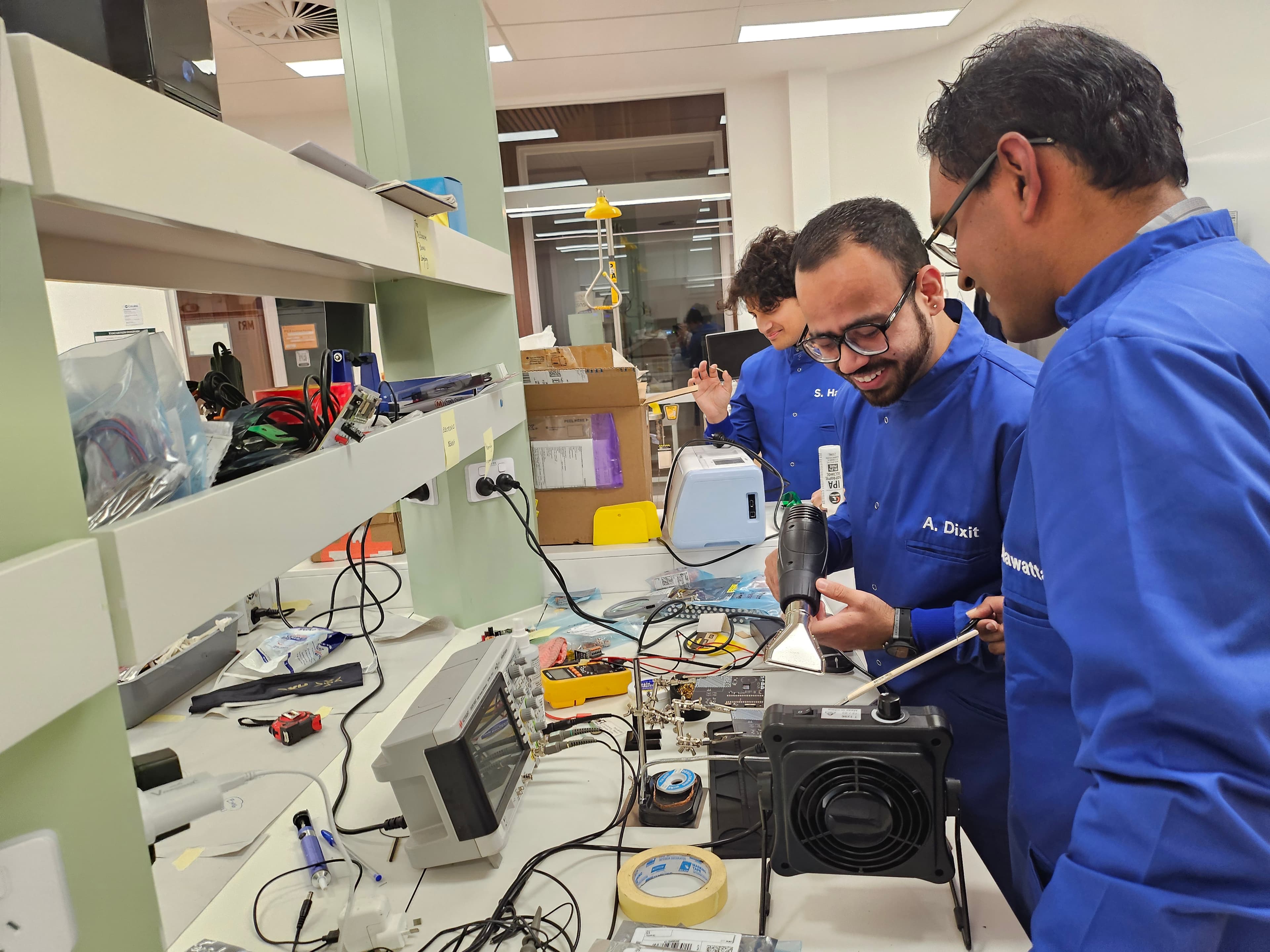
Building Ares: a lower-leg sensing sleeve combining IMUs, surface EMG, and force and pressure sensing to detect non-contact injury risk in elite athletes before it becomes an injury. Starting with ACL mechanisms in women's team sport, where incidence is disproportionately high and a single injury can sideline a player for nine to twelve months.

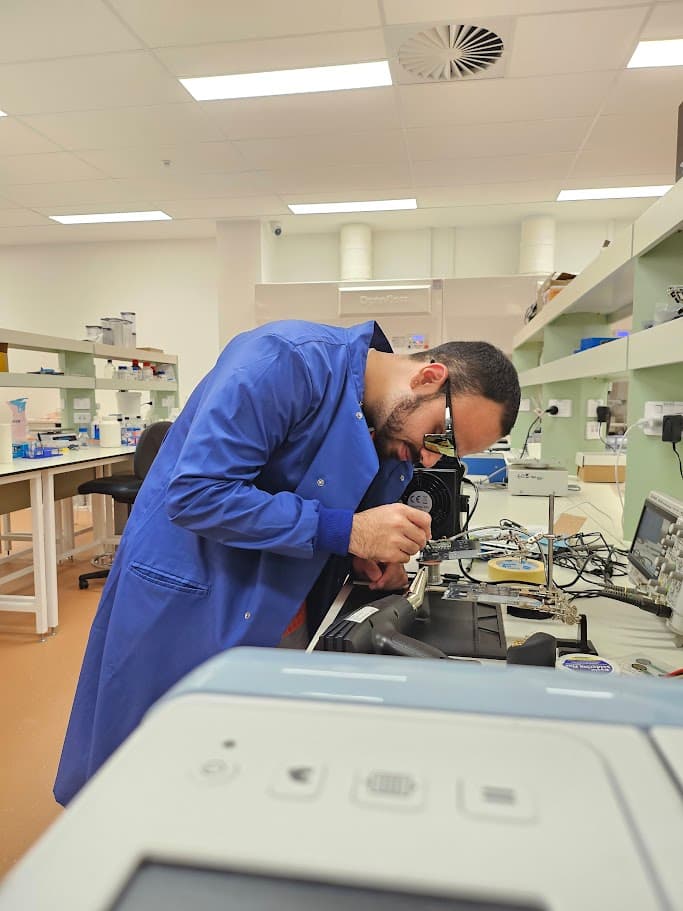
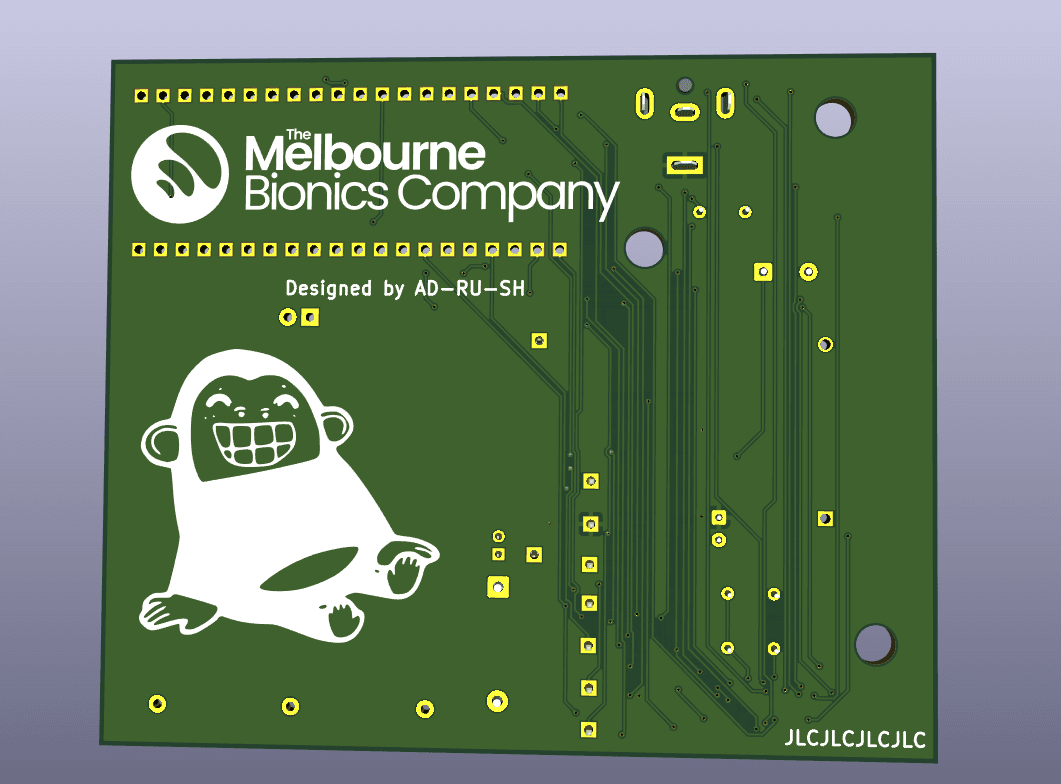
My work spans the full hardware arc: circuit simulation and system-level modelling, control PCB design from schematic through manufacturing files, board bring-up and verification, cross-device communication architecture, power IC evaluation and integration, structured test case development, and technical documentation to IEEE standards.

Every design decision balances sensing fidelity against wearability, battery life against sample rate, and clinical rigour against field practicality. The long-term vision extends beyond sport: the multimodal dataset Ares generates becomes a second product — motion priors derived from elite human performance, for robotics and embodied intelligence research.

This is where silicon meets the human body. Getting it wrong has real consequences.

Hardware bring-up at Melbourne Bionics lab
Testing the Ares control board
Ares control PCB — Melbourne Bionics

Social Enterprise

Mar 2025 – Present
Melbourne, Australia

ReviveTech

Founder

The digital divide is not a generosity problem. It is a decision friction problem.

Hundreds of millions of devices are discarded every year — not because they are broken, but because nobody can efficiently determine what to do with them. The intent to reuse exists. The infrastructure to act on it does not.

ReviveTech is building RUDS: a privacy-first diagnostics and recommendation pipeline that takes a device and outputs one of four paths — reuse as-is, repair then reuse, needs human inspection, or recycle. No guesswork. A clear answer.

The longer-term vision is a shared Device Passport standard: a common format that lets refurbishers, schools, nonprofits, and device banks interoperate — so a laptop assessed in Melbourne can be matched to a classroom in regional Victoria without duplicating work.

Building the foundation before talking loudly about it.

Circuits · Education

Jun 2024 – Present
Clayton, Australia

Monash University

Teaching Associate

Teaching circuit theory to undergraduate engineers. Bridging the gap between the abstraction of the classroom and the reality of the bench. I teach because I remember what it felt like to be a student who could sense the theory but couldn't yet see the practice. The bridge between those two worlds is a person who has done both.

Open Hardware

Nov 2025 – Present
Melbourne, Australia

Pebbl Tech

Hardware Contributor

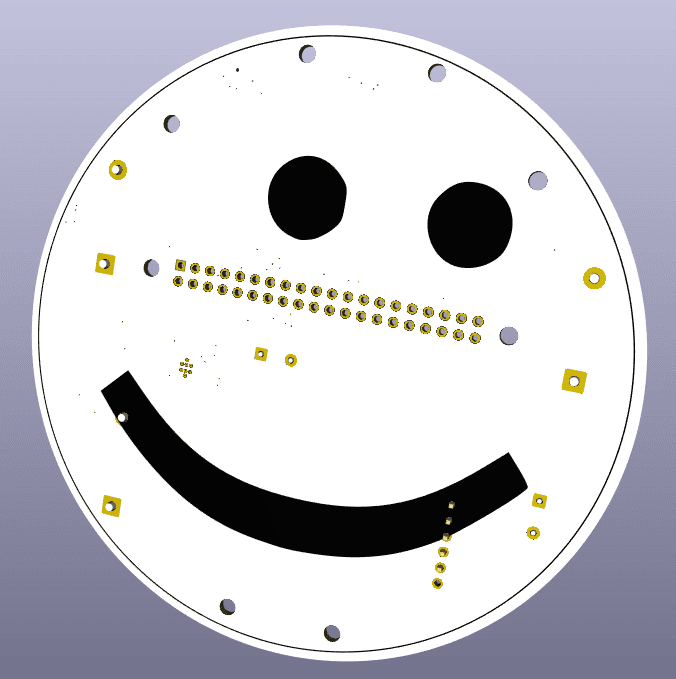
Contributing to human-first hardware designed for people with ADHD and AuDHD. The original Pebble proved you could build technology people genuinely loved without making it disposable. Pebbl Tech carries that ethos forward with modular, open hardware that respects how people actually think and work. My contribution is on the circuit design and hardware iteration side — in service of a product philosophy I believe in.

Pebbl PCB design render

FPGA · RTL Design

Dec 2024 – May 2025
Adelaide, Australia

AICRAFT

Embedded Systems Engineer

FPGA-based real-time processing. RTL design in VHDL and Verilog. Memory pipeline architecture, static timing analysis, hardware-in-the-loop testing. The kind of low-level work where every nanosecond is a design decision.

Medical Devices · ECG

Jul 2024 – Oct 2024
Melbourne, Australia

Biosignals Diagnostics

Product Engineering Intern

Contributed to the development of a portable ECG monitor. Component selection, PCB layout, and STM32L4 firmware for ECG signal processing, filtering, and transmission. First real encounter with the weight of building hardware that touches a human body.


"The most interesting problems live at the boundary: where hardware meets biology, where precision meets uncertainty."

Hardware

FPGA · PCB Design · Embedded · Altium

Signals

EMI/EMC · SPI · I2C · UART · CAN

Software

C/C++ · Python · VHDL/Verilog · Rust

Systems

TinyML · ROS2 · STM32 · Arduino


Selected Projects

Final Year Project · Monash University, 2024

TENG-Based Human-Computer Interface

Designed and built a triboelectric nanogenerator-based interface for enhanced movement tracking, aimed at assisting individuals with motor disabilities. Selected triboelectric materials (Ecoflex) for signal generation and comfort. Designed a custom PCB with FSR sensors and transmission circuitry.

Biosignals Diagnostics, 2024

Portable ECG Monitor

Contributed to component selection, multi-layer PCB layout, and STM32L4 firmware for ECG signal processing, filtering, and Bluetooth data transmission. First encounter with the weight of building hardware that a human body depends on.

University Project

Autonomous Tennis Ball Collector

Combined OpenCV computer vision with control systems for a robotics platform that identifies, navigates to, and collects objects autonomously. Introduced me to the gap between simulation and physical reality.